Simplifying Dual-End MIPI I3C® Logic Translator Validation Without the Complexity

Discover how a unique validation use case was transformed into an efficient, scalable workflow with complete compliance and minimal overhead.

The advancement of technology and its applications in domains like automotive ADAS, wearable sensor fusion, and modular industrial systems has led to tighter integration of sensors and controllers within electronic systems. This evolution demands high-speed, multi-device communication over compact PCBs, often through a single communication bus.  

While protocols like MIPI I3C® are designed to support high-bandwidth, low-power communication, they come with physical layer limitations on how many devices can be connected to a single bus. Logic translators overcome this constraint by isolating a group of devices into a secondary bus while maintaining seamless communication with the main bus. However, validating a MIPI I3C® logic translator is a nuanced process with unique considerations.  

This case study delves into the customer’s specific validation needs, the challenges posed by this unique use case, and how Soliton helped simplify the process and ensure precise protocol compliance. 

Breaking Down the Customer’s Validation Needs 

One of our customers, a prominent semiconductor company, developed a I3C logic translator to bridge between the main controller and additional target devices. Unlike validating a standalone MIPI I3C® controller or target device, the validation of a logic translator introduces added complexity. Here, both the input (controller-facing) and output (target-facing) interfaces must be tested simultaneously. This dual-end validation posed significant challenges in terms of setup, coverage, and precision. 

Achieving thorough validation meant addressing the following core requirements: 

  • Bi-directional Protocol Validation 

Conduct protocol transactions and validate both, the controller-facing and target-facing interfaces simultaneously. This required emulating protocol activity on one side, capturing and decoding it on the other, and verifying end-to-end compliance with MIPI I3C® specifications. Given that most tools support only one role at a time, this dual-role emulation and synchronized validation setup added a layer of complexity that traditional methods struggled to manage efficiently. 

  • Maintaining Signal Integrity Across Interfaces 

Sweeping, measuring, and correlating key bus parameters, such as voltage, timing, and frequency, across operational ranges was essential to evaluate the translator’s performance and ensure compliance. It was equally important to confirm that the data maintained its fidelity, free from any signal distortion. Meeting this requirement involved developing custom test scripts to coordinate voltage and timing variations at each end and manually collecting the resulting data. 

  • Precise Propagation Delay Measurement 

Propagation delay refers to the inherent latency introduced as signals pass through the logic translator. Even a few nanoseconds of propagation delay can disrupt signal alignment in timing-sensitive I3C systems. To prevent issues such as clock skew, data corruption, or false failures, the customer needed to measure this delay with high precision and ensure it stayed within the strict limits defined by the specifications. 
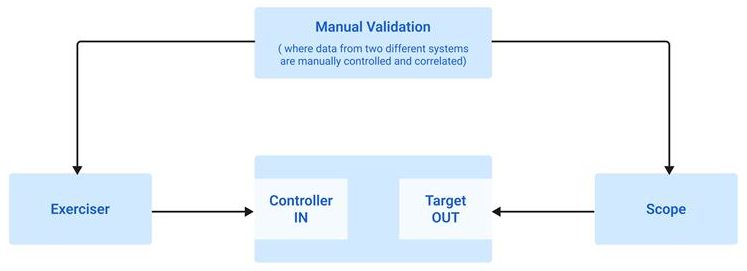
Customers pain point with Logic Translator

Architectural diagram of the validation setup before PVS

Legacy validation setups involved multiple instruments and complex manual coordination to achieve dual-end emulation. Off-the-shelf tools were not readily equipped to model the translator’s behavior, and custom test benches often demanded considerable time and engineering effort. To address these challenges efficiently, the customer required a unified, protocol-aware validation environment that could deliver thorough, specification-compliant results. 

Solving the Translator Validation with a Smarter Approach 

To meet the customer’s unique validation requirements, Soliton extended its MIPI I3C® Protocol Validation Suite to support logic translator validation. More specifically, here’s how the enhanced PVS addressed the customer’s core requirements: 

  • Unified Dual-Role Emulation with PVS 

PVS provided a unified environment capable of emulating both the controller-facing and target-facing interfaces simultaneously. With Controller and Target Validation capabilities, the tool generated protocol transactions and enabled synchronized validation across the translator from both the ends. This simplified the test setup, reduced integration effort, and ensured complete coverage of the translator’s behaviour under real-world conditions. 

Logic Translator Use CaseArchitectural diagram of how the PVS I3C validation suite seamlessly interfaces with the customer’s workflow


  • Automated Parameter Sweeps and Real-Time Correlation 

With its built-in automation capabilities and a drag-and-drop interface, PVS replaced manual scripting, allowing voltage, timing, and frequency sweeps to be executed directly from the software interface efficiently. Moreover, the tool allowed the customer to: 

    • Automatically sweep the timing and voltage values, capture results, and monitor whether the translator-maintained signal integrity throughout.  
    • Flagged deviations in real-time with conditional triggers with detailed logs and annotated waveforms for rapid root-cause analysis. 


  • Propagation Delay Validation with PVS 

To support this use case, the I3C Validation Suite was extended to measure propagation delay across the logic translator. This adaptation enabled the customer to calculate the delay at both ends of the translator with high accuracy and validate it against system-level timing requirements. 

Tangible Benefits Delivered Through PVS 

Tangible Benefits Delivered Through PVS

With Soliton’s Protocol Validation Suite, the customer achieved full MIPI I3C® logic translator validation, covering compliance at both ends, ensuring precise delay measurements, and eliminating the need for complex custom setups. The tailored, out-of-the-box solution helped accelerate development while saving engineering effort and capital. 

If you’re tackling complex validation scenarios, we’re here to help you simplify and succeed.