Validation Cycle Time That Took 4 Hours is Now Reduced to 36 Minutes with PVS

Learn how PVS addressed the challenges of in-house validation tool and achieved faster testing, minimal rise time, and expanded test coverage.

Ensuring industry-standard protocol compliance is critical for a product’s long-term success in the market. Digital protocol validation is traditionally performed using in-house solutions or protocol exercisers/decoders, involving protocol emulation, decoding, analysis, and report generation. However, this approach is often resource-intensive, requiring significant hardware, software, protocol expertise, and costs.  

This case study showcases how adopting PVS (Protocol Validation Suite) transformed the protocol compliance process by cutting validation time from hours to minutes, expanding test coverage, and significantly reducing engineering effort. 

Our Customer’s Struggle with In-House Validation Tool and the Need for a More Efficient Solution 

A leading semiconductor company renowned for its innovative chip designs and industry leadership relied on an in-house tool to validate I2C and I3C protocols. However, the tool lacked scalability and was challenging to enhance for evolving industry needs. Setting up the validation environment took at least three months and required constant expert support. As validation grew more complex, each update demanded extensive refactoring, diverting engineering resources from core testing and analysis.

1. Executing a Single Temperature Validation Cycle Took Approximately 4 Hours 

The customer sought to validate whether the Device Under Test (DUT) adhered to the required timing specifications and behavior across a range of operating temperatures. The in-house validation tool took approximately 4 hours to validate a single temperature, as it needed extensive manual configuration for each test, setting up parameters, and verifying results.   

2. Only Achieve Rise Time Down to a Minimum of 40 ns 

The customer needed to characterize the rise and fall time behavior of the DUT. Their in-house tool, however, could only achieve rise time down to a minimum of 40 ns. This limitation restricted their ability to accurately characterize the DUT’s actual response and determine its fastest possible transitions.  

3. Manual & Complex Bit-Level Configuration  

The in-house validation tool required engineers to manually configure high/low signal transitions for each bit and define precise timing parameters. For clock and data lines, this meant programming each bit sequence manually, increasing validation time and complexity. Additionally, engineers needed in-depth protocol knowledge to set up and debug signal generation. 

4. Limited Coverage & Flexibility in In-House Validation  

The customer’s in-house validation tool was built for specific test cases, limiting the overall coverage.  

  • Key gaps in electrical, timing, and functional validation increased the risk of missing fault and glitch test conditions.  
  • Expanding coverage, such as testing frequency limits, voltage levels, and fault injection, required significant effort. 
  • Each new validation parameter demanded manual updates, scripting, and debugging, making the process slow and resource-intensive.  

These challenges made it difficult to scale validation efficiently.

How PVS Revolutionized the Customer’s Validation Process, Making It Faster and More Efficient

As market demands evolved, the customer sought to enhance their validation capabilities, ensuring broader test coverage, faster execution, and more effortless scalability. To meet their specific requirements, they explored a solution that could complement their existing process. This led them to PVS. With its advanced automation, precision, and seamless integration, PVS transformed their validation process, eliminating bottlenecks and significantly improving efficiency.

Here’s how PVS addresses the challenges of protocol compliance:

1. Reduction in Temperature-based Validation Cycle Time

With PVS, the 4 hour validation process for a single temperature was reduced to just 36 minutes, translating to a time savings of over 3.5 hours per test. When scaled across multiple temperature points, this resulted in a drastic 85% reduction in the time taken to perform these tests

Instead of requiring engineers to set parameters and trigger tests for each temperature manually, PVS seamlessly integrates with the existing temperature automation system to execute validation runs in parallel with temperature changes. Once the temperature chamber is set and the system settles, PVS can automatically be triggered (via DLLs or scripting interfaces in languages like Python or C#) to perform the validation tests.


2. Achieved Minimum in Rise time  of 5 ns   

The high signal rise time can be attributed to the additional capacitance due to the cable inherent when developing the in-house validation tool. By utilizing the PVS Interposer Board, which incorporates buffer circuits, the rise and fall times have been reduced to as low as 5 ns, significantly improving signal integrity.  
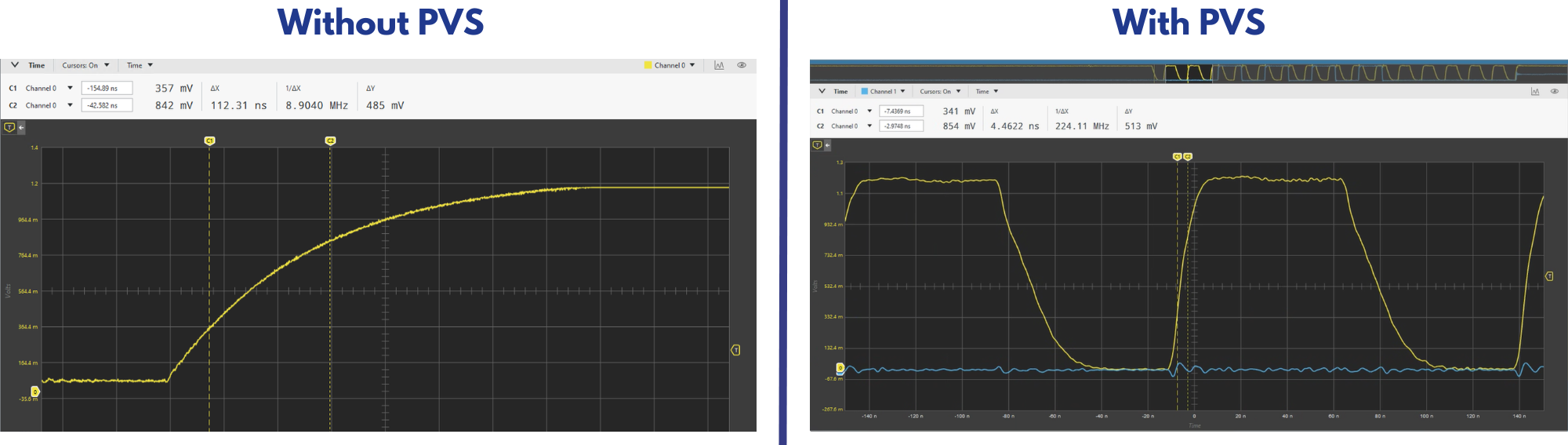
Rise time with and without PVS


3. A 100% Test Coverage with PVS 

PVS provides a comprehensive validation suite with continuous updates, covering a broad range of electrical, timing, and functional parameters out-of-the-box. Engineers can effortlessly configure tests through an intuitive GUI, eliminating the need for manual scripting or tool modifications.

If additional parameters, such as minimum/maximum frequency, voltage levels, or new test conditions, need to be validated, PVS allows engineers to define and execute them easily within the GUI. PVS’s support team quickly enabled them, eliminating engineering overhead.


4. Manual & Complex Bit-Level Configuration  

PVS eliminated manual bit-level setup and reduced onboarding time from months to weeks. 

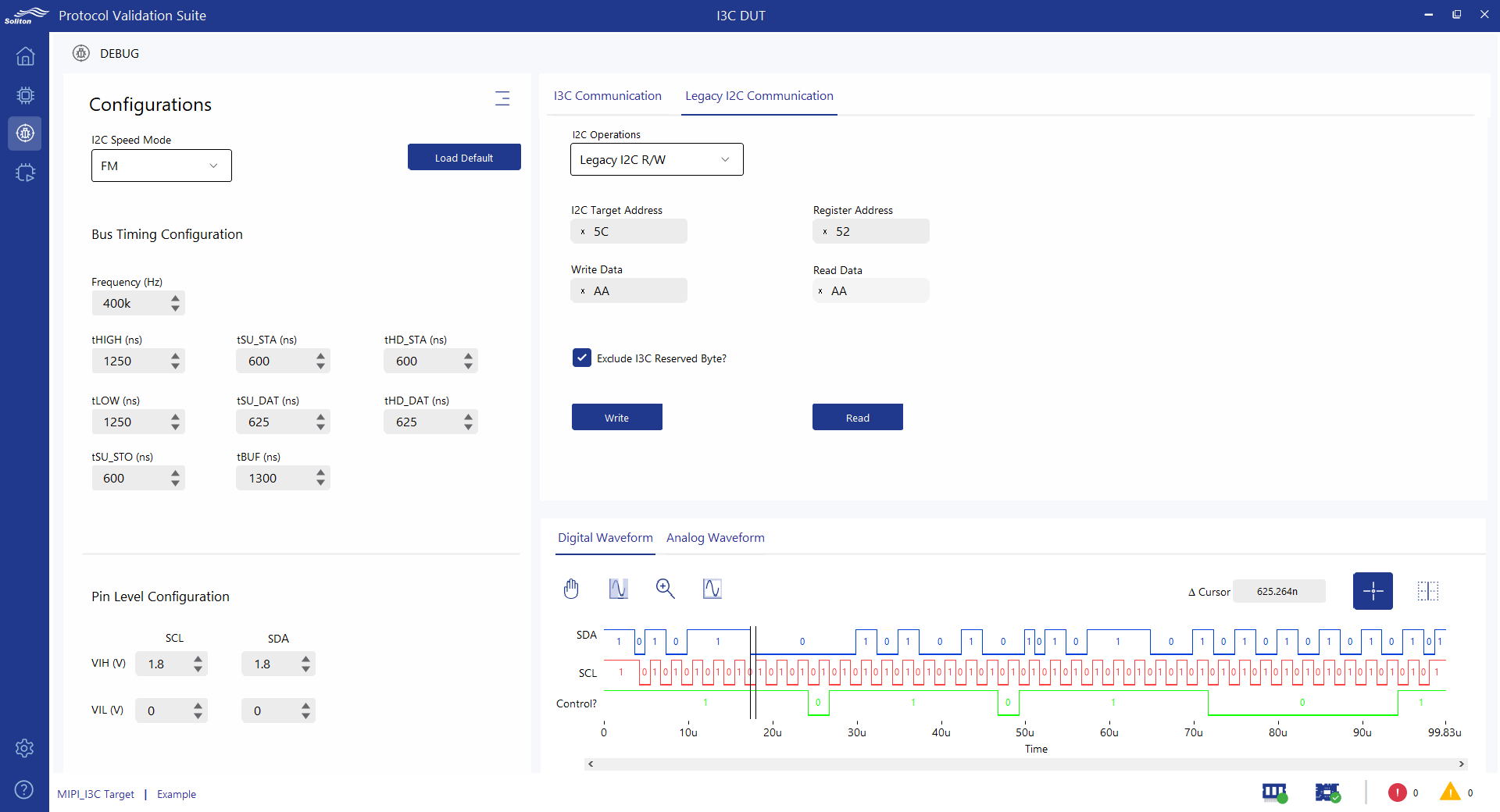
PVS allows engineers to generate waveforms effortlessly using a simple hex format. 

  • Instead of configuring 10101010 bit-by-bit, engineers can input 0xAA, and PVS automatically generates the correct signal pattern with precise bit placement and timing. 
  • Automated signal mapping ensures reliability without requiring manual fine-tuning. 
  • Engineers can validate signals without deep protocol knowledge, significantly streamlining the onboarding process. 

PVS Debug Screen

PVS – A New Benchmark in Protocol Compliance 

Our customer rated their experience with PVS an exceptional 11/10, recognizing its seamless onboarding, robust automation, and effortless integration. With PVS, our customer transformed their validation efficiency and set a new benchmark for protocol compliance testing.

“It was a wonderful experience with Soliton’s PVS I3C tool. It helped us save a lot of time in the validation process and money spent on development.”

– Validation Manager, Leading Semiconductor Company 

No more complex setups or long deployment times. With PVS, protocol validation is simple and efficient. Install the application, complete onboarding, set up in just a few hours, and start validating.
Interested to see the tool in action? Schedule a demo today.